
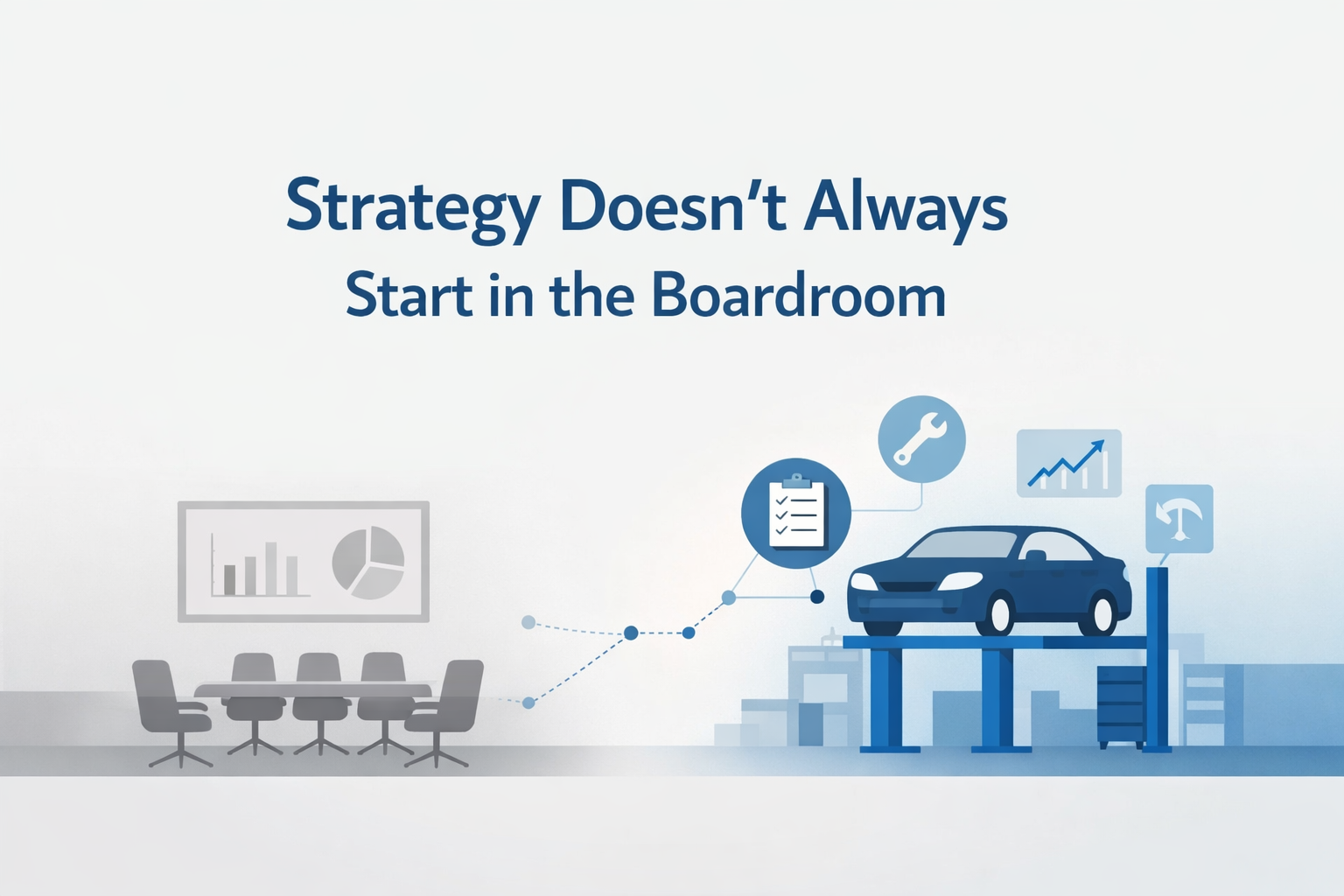
Most dealership strategy conversations start with market trends, inventory constraints, or pricing pressure. Rarely do they start where customers show up most often: the service lane.
Yet every service visit quietly produces signals. Not insights yet — just signals. Patterns in mileage. Repeated repairs. Shifts in ownership cycles. Warranty milestones. All of this is logged, processed, and filed away as routine operations.
What’s overlooked is not the presence of data.
It’s the fact that strategy is already forming there — just not being read.
A service drive doesn’t just document vehicle condition. It documents change over time.
Taken individually, these are transactional details.
Seen together, they form a narrative of when customers move from maintaining to reconsidering.
The data already maps the customer journey. Most dealerships simply don’t treat it that way.
The problem isn’t data availability. It’s interpretation.
Service systems are designed to complete today’s job, not to surface tomorrow’s opportunity. CRMs and DMS platforms capture enormous volume, but they weren’t built to translate operational exhaust into strategic direction.
Manually, this is almost impossible. The signals are fragmented across records, time periods, and systems. Patterns exist — but they don’t announce themselves.
This is where AI changes the nature of what service data can become.
AI doesn’t add new data. It changes what existing data can be used for.
Instead of static records, patterns begin to emerge:
What used to be hindsight becomes timing.
What used to be anecdotal becomes repeatable.
The shift isn’t automation for efficiency.
It’s interpretation for decision-making.
Most inventory planning is reactive. Dealers compete in auctions, respond to wholesale volatility, and adapt to what becomes available.
Service lane intelligence introduces a different dynamic: foresight.
When service patterns show a wave of vehicles approaching high-maintenance phases, that’s not just a service insight — it’s an inventory signal. When certain segments show consistent lifecycle behavior, that’s demand visibility forming inside the dealership itself.
The service drive becomes an early indicator of what will likely surface into the pre-owned pipeline.
Not guaranteed volume — but informed expectation.
That changes how inventory risk is managed.
Market pricing tools tell you what vehicles sell for.
Service history tells you what those vehicles have been through.
When internal service records are layered into pricing logic, vehicles stop being abstract SKUs. They carry operational context — condition trajectories, repair patterns, ownership history.
This doesn’t replace market alignment.
It sharpens it.
Pricing becomes less about averages and more about evidence.
Customer retention isn’t driven by isolated offers. It’s driven by continuity.
Service behavior already reveals loyalty signals:
When these signals are analyzed as patterns rather than events, loyalty stops being reactive. Engagement becomes timed to behavior, not campaigns.
This is less about messaging volume and more about relevance.
The service lane has always been operationally important. What’s changing is its strategic weight.
When AI connects service history, customer behavior, and market context, the service drive stops being a cost center narrative and starts becoming a decision layer.
The advantage isn’t external.
It’s already running through the dealership every day.
The only real change is whether it’s being interpreted — or ignored.